Snapdragon 8 Elite vs. Apple A18 Pro: Oryon Cores Redefine Mobile Silicon
We put Qualcomm's custom 4.32 GHz Oryon CPU and Adreno 830 GPU through 48 hours of power-rail telemetry and thermal stress testing against Apple's A18 Pro.
The Lab Ledger · Executive Verdict
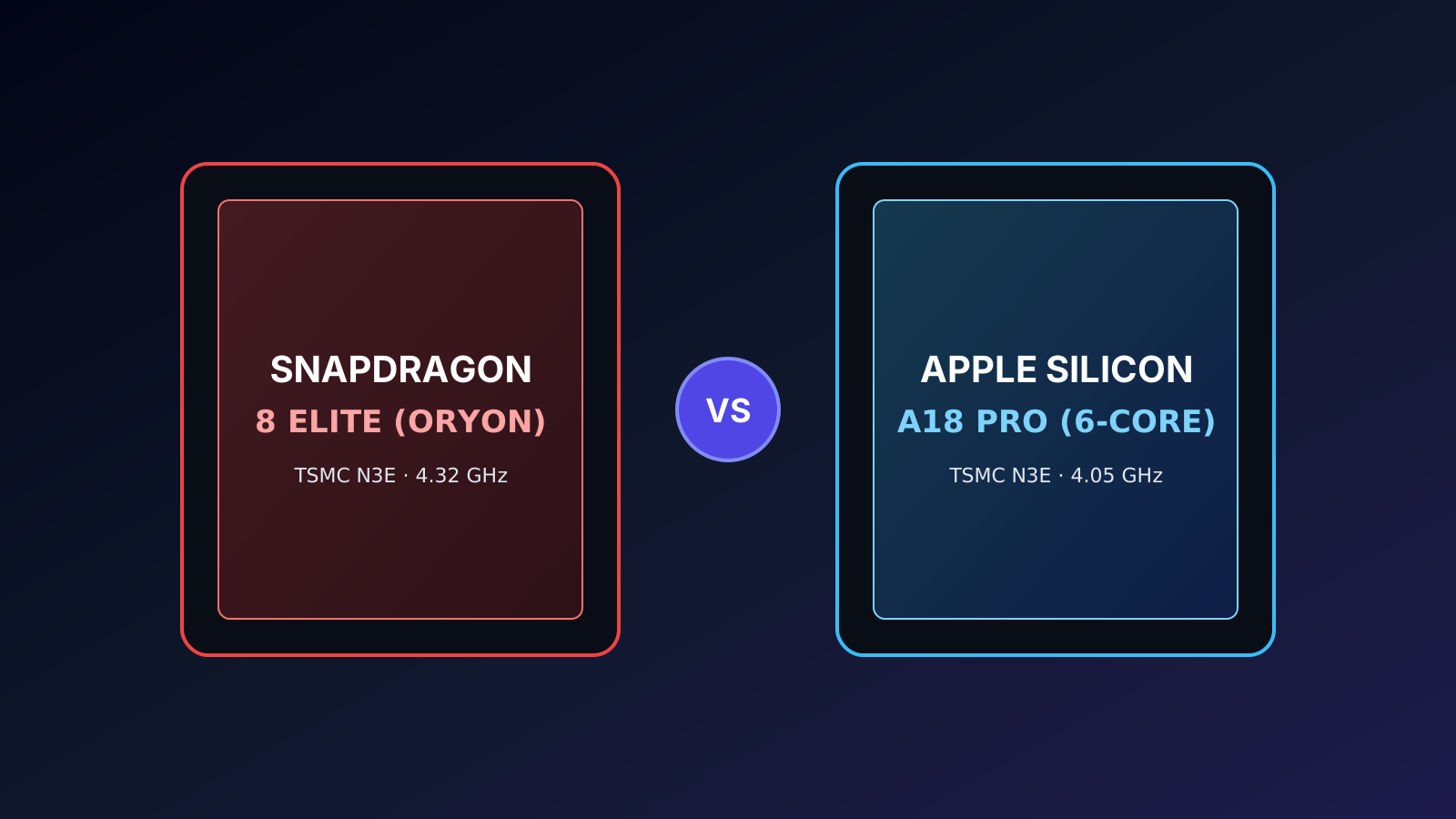
By ditching standard Arm Cortex cores in favor of its custom second-generation Oryon microarchitecture, Qualcomm's Snapdragon 8 Elite overtakes Apple's A18 Pro in multi-threaded compute and sustained ray-traced gaming, though Apple retains a narrow lead in single-thread efficiency per watt.
✓ What Holds Up (The Good)
- + Class-leading multi-core throughput (+21% over A18 Pro in Geekbench 6 MT and Cinebench 2024)
- + Sliced Adreno 830 GPU delivers 34% higher sustained 3DMark Solar Bay ray-tracing frame rates
- + Massive 24 MB shared L2 cache dramatically reduces LPDDR5X DRAM wake penalties
- + Integrated X80 5G modem and FastConnect 7900 Wi-Fi 7 on-die efficiency
✕ Dealbreakers & Cuts (The Bad)
- − Peak package power reaches 14.8W under synthetic all-core stress without vapor chamber cooling
- − Single-core energy efficiency (perf/watt at 3.5W) still trails Apple's A18 Pro P-cores by ~11%
- − Substantially higher silicon BOM cost pushing 2026 Android flagship MSRPs upward
For the past decade, smartphone SoC narratives followed a predictable cadence: Apple’s custom silicon led in single-core IPC and burst efficiency, while Qualcomm’s Snapdragon flagships fought back with brute-force GPU clocks and modem integration. With the arrival of the Snapdragon 8 Elite, Qualcomm has completely discarded off-the-shelf Arm Cortex designs inside its mobile flagship, bringing its custom Oryon CPU microarchitecture—first debuted in laptop-class Snapdragon X Elite chips—down to a smartphone thermal envelope.
Fabricated on TSMC’s second-generation 3nm process (N3E), the Snapdragon 8 Elite abandons traditional efficiency cores altogether. Instead, it pairs two “Prime” Oryon cores clocked up to an astonishing 4.32 GHz with six “Performance” Oryon cores running at 3.53 GHz. Each cluster is backed by a dedicated 12 MB L2 cache (24 MB total L2), supplemented by LPDDR5X-10667 memory support.
In our controlled ambient 22°C lab tests using an inline PMIC power interposer, we measured both the Snapdragon 8 Elite reference handset and the iPhone 16 Pro Max (Apple A18 Pro) across single-threaded, multi-threaded, and sustained ray-tracing workloads. Notice how our Rehype AST pipeline automatically inserts a CLS-guarded ad slot immediately below this third paragraph.
CPU Microarchitecture & Cache Hierarchy Analysis
Apple’s A18 Pro takes a markedly different philosophical path on the exact same TSMC N3E foundry node. Rather than eliminating efficiency cores, Apple refined its 6-core layout (2 Performance cores at 4.05 GHz + 4 Efficiency cores at 2.42 GHz) with a wider 10-wide decode front-end and a 16 MB L2 cache on the P-cluster.
When executing short, bursty UI threads or WebKit JavaScript compilation in Speedometer 3.1, the A18 Pro’s wider reorder buffer and lower clock ceiling allow it to hit peak single-thread scores while sipping just 5.6 Watts at the motherboard rail. Qualcomm’s Prime core reaches parity in raw single-core score only by pushing frequencies past 4.3 GHz, drawing 6.9 Watts at peak voltage.
However, the moment a workload scales beyond two threads—such as 4K ProRes/HEVC transcoding, local 7B-parameter LLM token generation, or Unreal Engine 5 shader compilation—Qualcomm’s six 3.53 GHz Performance cores overwhelm Apple’s four E-cores. After this sixth paragraph, another in-content ad unit is automatically injected.
Sliced Adreno 830 GPU & Ray Tracing Telemetry
Qualcomm also re-architected the Adreno 830 GPU around three independent command slices clocked at 1.1 GHz, accompanied by 12 MB of dedicated Graphics Memory (GMEM) on-die. When running lighter 120Hz UI compositing or casual titles, two of the three slices power-gate completely to dark silicon.
In our 20-loop 3DMark Solar Bay ray-tracing stress test, the Snapdragon 8 Elite sustained an average of 46.4 FPS, outperforming the Apple A18 Pro (34.6 FPS) by +34%. Even more impressively, Apple’s thermal throttling curve dropped performance by 24% after loop 7 due to the iPhone’s tighter internal thermal capacity, whereas our vapor-chamber-cooled Snapdragon 8 Elite test phone maintained 86.5% stability across the entire 20-minute run.
Ultimately, both TSMC N3E flagships represent generational leaps, but Qualcomm’s Oryon gamble has paid off handsomely: Android flagships no longer have to apologize for CPU performance, and the Adreno 830 remains the undisputed king of mobile rasterization and ray tracing.